Hundreds of Thousands of Migratory Birds Visit Kentucky and Indiana Each Year
If you've ever looked up at the sky and seen what appeared to be an endless stream of birds flying overhead, there's a good chance you were witnessing part of an extraordinary natural phenomenon happening right here in our region. I saw something like that just this weekend and pulled over to the side of the road to observe. Fascinating and humbling, really.
Every year, hundreds of thousands of migratory birds travel through or spend the winter in the wetlands of southwestern Indiana and western Kentucky. Some of the gatherings are so enormous that they can be difficult to comprehend until you see them for yourself.
The birds include Snow Geese, Tundra Swans, Trumpeter Swans, American White Pelicans, Sandhill Cranes and even the endangered Whooping Crane.
And some of the numbers are remarkable.
According to Kentucky Fish and Wildlife, Sloughs Wildlife Management Area, located west of Henderson, hosts as many as 40,000 geese and 30,000 ducks annually.
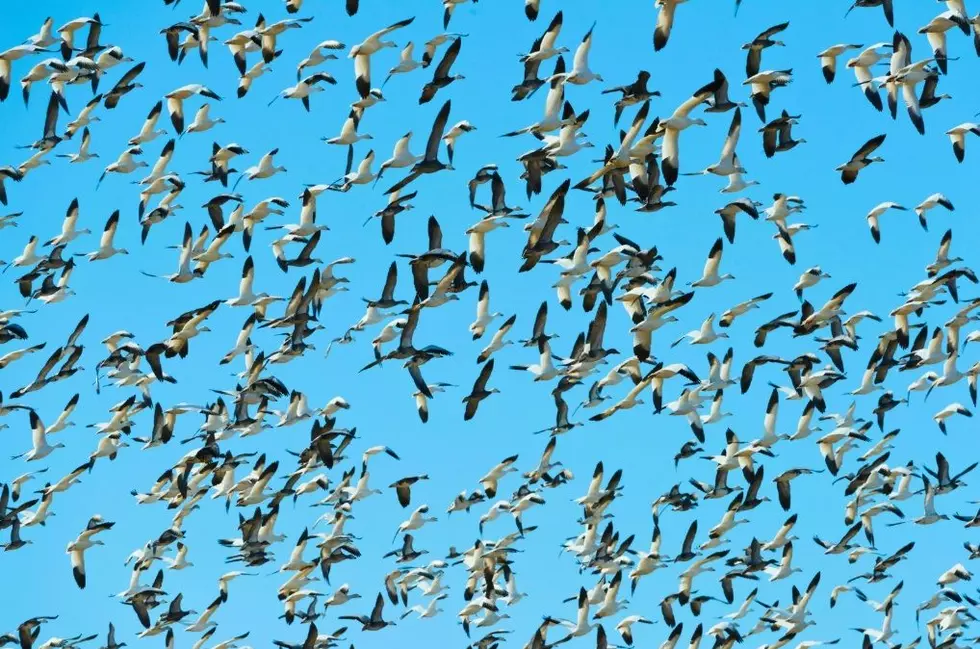
University of Southern Indiana instructor and filmmaker John Morris recently described witnessing more than 100,000 Snow Geese lifting off from a lake and heading toward nearby farm fields. He also documented the calls of thousands of Sandhill Cranes.
The enormous flocks of Snow Geese that visit our region during migration can be difficult to imagine until you see them in flight. This video, narrated by wildlife documentarian Rick Andrews, captures a remarkable Snow Goose migration in Alberta, Canada. While the footage wasn't filmed here in the Ohio Valley, it offers a glimpse of the incredible sights that accompany these seasonal journeys.
It's quite a spectacle, and it's happening in places many people around the Tri-State might not even realize.
Why Do So Many Birds Come Here?
Southwestern Indiana and western Kentucky offer suitable wetlands, resting areas, and access to food, something migrating birds need during their long journeys.
The region's river floodplains, marshes, lakes and agricultural fields provide important habitat for birds traveling south for winter or stopping along their migratory routes.
Where Can You See These Birds?
One particularly interesting destination is Hovey Lake Fish and Wildlife Area near Mount Vernon, Indiana. The property encompasses more than 7,400 acres of wetlands, sloughs, woods and other habitats that attract a wide variety of birds.
Other important locations include Cane Ridge Wildlife Management Area near Princeton and Goose Pond Fish and Wildlife Area near Linton.
These natural areas aren't simply beautiful places to visit. They play an important role in helping migratory birds survive their seasonal journeys.
A New Documentary Highlights the Migration
The remarkable wildlife activity has inspired a new documentary called "Winter Wings over the Wabash: Our Large Migratory Birds."
Morris, a senior instructor at USI, spent more than two years working on the project, capturing footage and learning more about the birds and the habitats they depend on.
The documentary will have its first public screening at 7 p.m. Tuesday, November 17, at the University of Southern Indiana in Evansville.
The screening will take place in Kleymeyer Hall in the Liberal Arts Center.
Morris hopes the documentary will help people recognize the ecological importance of these wildlife areas and understand why protecting them matters.
It's also an opportunity for people in western Kentucky and southern Indiana to discover something extraordinary that's been happening in their own backyard for generations.
The next time you hear thousands of birds calling overhead, you might want to take a moment and look up.
LOOK: Here are the states where you are most likely to hit an animal
Gallery Credit: Dom DiFurio & Jacob Osborn
More From WBKR-FM